
Mid-Year Housing Market Update: What the Revised 2026 Forecast Means for Buyers and Sellers in the Midwest and Florida
If the housing market feels a little confusing right now, you’re not alone.
Mortgage rates have remained higher than many experts expected, home sales haven’t accelerated as quickly as forecasted, and buyers and sellers across the country are wondering what comes next.
The reality is that a lot has changed during the first half of 2026.
At the end of 2025, economists anticipated a stronger housing market this year. Many projected mortgage rates would fall more significantly, affordability would improve, and home sales would rebound.
Instead, persistent inflation concerns, economic uncertainty, and global events have kept mortgage rates elevated longer than expected. As a result, many prospective buyers have continued to wait on the sidelines.
That’s why several leading housing organizations recently revised their forecasts for the remainder of 2026.
So what does that mean if you’re buying or selling in markets like Omaha, Lincoln, Kansas City, St. Louis, Des Moines, Chicago, Tampa, Orlando, Sarasota, Fort Myers, or Jacksonville? Let’s take a closer look.
Mortgage Rates May Stay Higher for Longer
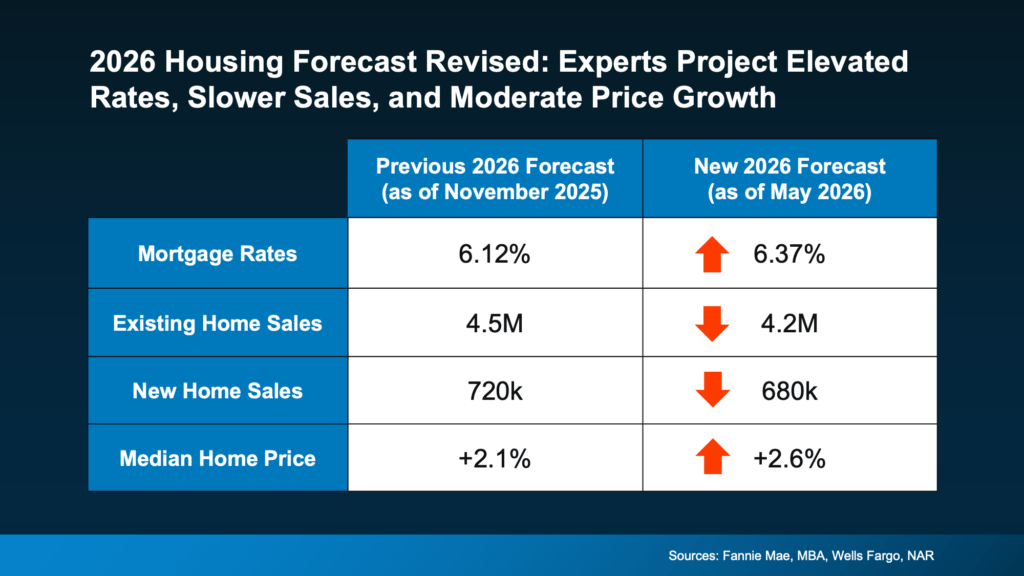
Many buyers hoped mortgage rates would settle into the upper-5% or low-6% range by now. While that remains possible in the future, most economists currently expect rates to remain in the mid-6% range through much of 2026.
The good news? Rates are still generally lower than they were at certain points over the past two years.
For buyers throughout the Midwest, this means affordability remains a challenge, but many local markets continue to offer more attainable home prices compared to coastal markets.
In Florida, elevated rates are impacting affordability as well, particularly in areas that experienced significant appreciation during the past several years. However, increased inventory in many Florida markets is creating opportunities that weren’t available a year ago.
As always, forecasts can change. If inflation cools more quickly or economic conditions shift, mortgage rates could improve. But waiting solely for dramatically lower rates may not deliver the savings many buyers are hoping for.
Home Sales Forecasts Have Been Revised Lower
Earlier projections called for approximately 4.5 million existing-home sales nationwide in 2026. Updated forecasts now place that number closer to 4.2 million.
This adjustment reflects a simple reality: affordability remains a challenge for many households.
In Midwest markets such as Omaha, Lincoln, Kansas City, Des Moines, and St. Louis, buyer activity remains relatively healthy compared to many parts of the country because housing costs are still comparatively affordable. However, higher monthly payments have caused some buyers to delay their plans.
In Chicago, affordability concerns vary significantly by neighborhood and price point, but many buyers are still taking a cautious approach.
Meanwhile, in Florida markets like Tampa, Orlando, Naples, Sarasota, and Fort Myers, buyers are benefiting from increased inventory and more options. While sales have slowed from the frenzied pace of recent years, motivated buyers are finding greater negotiating power.
The encouraging news is that experts still expect more homes to sell this year than last year. Many economists believe there is substantial pent-up demand waiting for improved affordability and greater confidence in the market.
We’re already seeing signs of that demand returning. In many regions, pending sales activity has shown improvement despite higher mortgage rates.
For buyers who are financially prepared today, purchasing now may mean facing less competition than they would if rates decline and more buyers re-enter the market.
New Construction Remains a Bright Spot
Builders also entered 2026 expecting a stronger year. Forecasts have since been adjusted downward, largely due to the impact of mortgage rates on affordability.
However, this may create opportunities for buyers.
Across many Midwest communities—including Omaha, Lincoln, Kansas City, and suburban Chicago—new construction remains an important source of inventory. Builders often continue offering incentives such as rate buydowns, closing-cost assistance, or upgraded features to attract buyers.
The same is true in many Florida markets, where new-home communities remain active throughout Tampa, Orlando, Fort Myers, Sarasota, and Jacksonville.
If you’re considering new construction, today’s market conditions may provide more negotiating leverage than buyers have had in recent years.
Home Prices Are Still Expected to Rise
Perhaps the biggest takeaway from the revised forecast is this:
Despite slower sales activity, experts have actually increased their expectations for home-price growth in 2026.
Nationally, home prices are still projected to appreciate modestly this year.
Why? Because while buyer demand has softened, housing inventory remains relatively constrained in many areas. That ongoing supply-and-demand imbalance continues to support home values.
Of course, every market is different.
In parts of Florida where inventory has risen significantly, price growth may be slower and buyers may have more negotiating room.
Meanwhile, many Midwest markets continue to benefit from steady demand, strong local economies, and inventory levels that remain below historical norms. Cities such as Omaha, Lincoln, Kansas City, and Des Moines have generally experienced more stable market conditions than some of the nation’s higher-cost regions.
While some local markets may see modest corrections or slower appreciation, most experts are not forecasting a widespread decline in home values.
That’s welcome news for sellers who want to protect their equity and for buyers who want confidence that their investment can continue building long-term wealth.
Bottom Line
The housing market isn’t moving quite the way economists expected six months ago, but that doesn’t mean opportunities have disappeared.
For buyers, today’s market may offer less competition, more negotiating power, and builder incentives that weren’t available during the height of the market.
For sellers, home values remain resilient, especially in many Midwest communities and desirable Florida markets.
Whether you’re buying your first home, moving up, downsizing, or exploring new construction, local market conditions matter more than national headlines. A trusted mortgage professional and real estate agent can help you understand what’s happening in your specific market and create a strategy that works for your goals.